Abstract: Santalum album L., a dried heartwood of the Santalaceae family, is a valuable medicinal herb and aromatic resource whose quality grading directly affects its clinical efficacy and market value. Based on traditional sensory evaluation methods and modern commercial grading practices, this study systematically presents a quality assessment system for sandalwood centered on buoyancy tests, visual characteristics, and a threefold olfactory analysis. Research shows that oil content in sandalwood correlates positively with its sinking rate, making it the primary physical indicator for classifying grades A (sinking grade), B (semi-sinking/semi-floating grade), and C (floating grade). The olfactory evaluation employs a tripartite comparative test involving room-temperature sniffing, water immersion, and low-temperature heating, effectively distinguishing natural sandalwood from artificial imitations based on aroma purity, complexity, and longevity. This three-tiered identification system—comprising physical buoyancy, visual observation, and olfactory testing—is simple to operate, clearly defined in criteria, scientifically sound, and accessible, making it suitable for rapid quality assessment by both consumers and industry professionals in market circulation. It provides an intuitive and practical technical solution for standardizing sandalwood product grading.
Keywords: sandalwood; quality grade; identification; volatile oil; sensory evaluation; commercial specifications
1. Objective
Sandalwood (Santalum album L.) is the dried heartwood of the sandalwood genus in the sandalwood family. Its use in traditional Chinese medicine dates back to the Tang Dynasty, and it has the effects of warming the body, regulating the qi, stimulating the appetite, and relieving pain. It is listed as a legally recognized Chinese medicinal material in the Chinese Pharmacopoeia [1]. At the same time, sandalwood holds an irreplaceable position in the fields of incense culture, carving craftsmanship, and daily fragrant materials due to its unique sweet and milky aroma foundation and long-lasting fragrance retention.
However, the natural resources of sandalwood are becoming increasingly scarce, and the market supply relies heavily on imports, resulting in persistently uncontrolled phenomena of substituting inferior products with genuine ones and passing off fakes as genuine. The quality of commercially available sandalwood varies, including those that use edge wood to imitate heart wood, those that are replicated by soaking in artificial fragrances, and those that are colored with other low-value woods to increase the value. The current classification standards in the Chinese medicinal market are rather arbitrary, and traditional identification experiences have not yet formed a systematic and operational normative system. Ordinary consumers and grassroots practitioners often lack clear and convenient evaluation criteria when facing the complex array of products [3].
In this context, it is of great practical significance to establish a quality grade identification method based on daily operational means, with distinct levels and clear judgment criteria. This paper aims to refine and systematize traditional sensory identification experience, focusing on three core dimensions: the submersion test, appearance observation, and odor triple test. A three-level classification system of Grade A (submerged level), Grade B (submerged floating level), and Grade C (floating level) will be established, and the boundaries and typical characteristics of each level will be clearly defined, in order to achieve the following goals: (1) Provide a simple and operational family identification guide for ordinary consumers; (2) Offer unified and standardized classification reference for sandalwood sellers and practitioners; (3) Provide a rapid quality evaluation scheme with scientific logic and practical value in situations where professional instrument detection conditions are limited.
2. Classification of Sandalwood Quality Levels Based on Physical Basis and Grading Standards
2.1 Intrinsic Relationship between Oil Content and Density
The quality of sandalwood fundamentally depends on the accumulation of oil (volatile oil) in the heartwood. During the long growth process of the sandalwood tree, the heartwood continuously secretes and stores aromatic oils. These oils not only carry the distinctive aroma of sandalwood but also cause significant changes in the physical properties of the wood. As the oil content increases, the density of the wood rises, and the texture becomes denser and harder, with the color shifting from light to deep and lustrous [3].
Therefore, oil content becomes the core determining factor for grading sandalwood. The heartwood of different parts of sandalwood accumulates oil unevenly. Generally, the heartwood near the root has an oil production rate of up to 10%, the trunk heartwood is second, and the edge wood contains almost no oil. This natural difference directly determines the commercial value and grade classification of different parts of sandalwood.
2.2 Grading Principles and Operating Specifications of the Submerged Test
The submerged test is a simple method for rapid preliminary grading using the principle that the oil content of sandalwood is positively correlated with density. Water serves as the natural detection medium with the buoyancy of water. Pure water has a density of approximately 1.00 g/cm³. Sandalwood with sufficient oil content naturally sinks due to its density being greater than that of water; conversely, those with thin oil content will float or suspend due to insufficient density.
The specific operation method is as follows: Place normal temperature water in a transparent container, gently place the entire sandalwood sample into the water, and observe its floating state after a short period of standing. Based on the proportion of sinking and the floating state, sandalwood can be clearly classified into three basic grades [2].
Grade A (Sinking Grade): When the entire sandalwood sample is placed in clear water, it can completely sink to the bottom without any part exposed above the water surface. This phenomenon indicates that the internal oil of the wood is extremely abundant, and the overall density is greater than that of water. In appearance, Grade A sandalwood is dark yellow to yellowish brown, with a significant lustrous effect, and the oil traces penetrating the texture can be clearly identified by the naked eye. The color is rich and deep, and the texture is solid and heavy.
Grade B (Sinking and Floating Grade): The sandalwood immersed in water shows a semi-sinking and semi-floating state, with approximately 71% to 99% of the wood submerged underwater, and a small part exposed above the water surface. This grade reflects moderate oil content, with the overall density of the wood being close to or slightly greater than that of water, but not reaching the condition of complete sinking. Grade B sandalwood has an appearance of dark yellow to yellowish brown, but the color is slightly lighter than Grade A, the oil luster is reduced, and the texture is still solid.
Grade C (Floating Grade): When the sandalwood is placed in water, no more than 70% of the wood is submerged underwater, and most of the volume floats on the water surface. This is the lowest grade of sandalwood with the lowest oil content, and the wood density is significantly less than that of water. In appearance, it mostly appears light brown to pale yellow, with a dry texture, lacking lustrous sheen, and a relatively loose texture.
2.3 Submersion Test
Based on the submersion test results, combined with the observation of appearance characteristics, the classification results can be further verified. High-quality sandalwood (Grade A) has an overall surface color of dark yellow or brownish yellow, smooth and fine, with a natural lustrous sheen; some raw materials may have blemishes or longitudinal cracks, and the cross-section appears yellow, with a full oil content area often presenting a translucent oily streak [4]. Grade B has a similar appearance but with a weakened lustrous effect, while Grade C is significantly dry and has a lighter color.
It is worth noting that color is not an absolute judgment criterion. Unscrupulous merchants often imitate the appearance characteristics of submersion-grade sandalwood through artificial coloring, oil application, etc. Therefore, appearance observation should be used as an auxiliary evidence for the submersion test, rather than the sole basis.
3. Triple Odor Test - The Core of Sensory Identification for the Quality of Natural Sandalwood
The submersion test can quickly reflect the oil content, but it cannot effectively identify artificial intervention methods. Some unscrupulous merchants artificially add artificial fragrances, resins, or other weight-increasing substances to low-quality wood to achieve the submersion effect. Therefore, odor identification has become the core环节 for determining whether the sandalwood is natural and of excellent quality. This article proposes a triple control experiment of normal temperature sniffing, water test, and heating, which comprehensively determines from three aspects: aroma background, aroma activation, and aroma purity [4].
3.1 Normal Temperature Sniffing - Identifying the Aroma Background
Take the sample to be tested, remove the packaging, and let it stand for 1 minute to allow the surface odor to naturally diffuse. Sniff directly without any pre-treatment.
Grade A sandalwood can emit a clear and rich milk aroma base at normal temperature, with prominent main fragrance, full and heavy aroma, and long-lasting fragrance. Grade B sandalwood also has a clear milk aroma, but the intensity is slightly inferior to Grade A. The overall aroma is stable and moderate. Grade C sandalwood only has the basic sandalwood aroma, with extremely faint milk aroma that is almost undetectable, and the overall fragrance is thin and soft, with less rich layers.
The core purpose of normal temperature sniffing is to determine whether the sandalwood has the characteristic aroma of naturalness - that is, the distinctive milk sweet aroma and the base aroma of sandalwood. If there is no obvious milk aroma or the aroma is weak, regardless of whether it is submersion or not, it should not be rated as a high grade.
3.2 Water Test Experiment - Observing Aroma Activation and Pigment Release
Take a small amount of sample and completely immerse it in clear water. After a moment, remove it and immediately observe and sniff the changes in the state of the wood and the water.
When natural sandalwood (including grades A, B, and C) is exposed to water, due to the infiltration effect of water molecules, the aromatic substances enclosed in the wood vessels are released, and the aroma will significantly spread and intensify, with a clearer layering effect than dry sniffing. At the same time, natural sandalwood wood does not fade during the soaking process, and the soaking water remains clear and transparent [5].
This is an important identification point to distinguish natural sandalwood from dyed imitations. If the water quickly turns yellow, brown, or other colors after soaking, or the surface color of the wood noticeably peels off, it indicates that the sample is likely to have undergone artificial dyeing treatment, and should be highly vigilant. Some dyed imitations may also add fragrances to achieve both appearance and odor duplication.
3.3 Heating Sniffing - Distinguishing Natural and Artificial Fragrances
Take a small amount of sandalwood powder and place it in a heating device (such as an electronic incense burner) and slowly heat at a low temperature (about 100-150°C). Continuously sniff the changes in the odor released during the heating process. This method is the key means to distinguish natural sandalwood from fragranced sandalwood soaked in artificial fragrances [2].
During the heating process of Grade A and Grade B sandalwood, the milk aroma and the sandalwood base aroma layer out layer by layer, the aroma penetration is significantly enhanced, and it is long-lasting and rich in variation. And there will be no any unpleasant smell throughout the process, and the heating time will not cause any sudden unpleasant smell. The aroma of Grade C sandalwood also expands and enhances the penetration, but the aroma layers are relatively simple and not as rich in variation. It still maintains the basic quality of no unpleasant smell.
Safety line: If a pungent, musty, burnt, or sour and rotten smell appears after heating, it indicates that the raw material is of poor quality, moldy and deteriorated material, or improperly treated raw materials. If the aroma is intense in the early stage of heating but quickly fades within 1-2 minutes until there is no smell, it highly suggests that it is an imitation sample soaked in artificial fragrances - the aroma of natural sandalwood has good persistence under heating conditions and will not volatilize completely in a short period of time.
4. Comprehensive Evaluation of Sandalwood Grades and Applicable Scenarios
Based on the combined results of the submerged test and the triple odor test, the characteristics of the three grades of sandalwood can be systematically summarized as follows. There are significant differences in quality performance and application directions among the three grades [3, 4].
Grade A (Submerged Grade): Full oiliness, entire piece submerged; Appearance is deep yellow and oily; Oil streaks can be seen; At room temperature, the milk aroma is rich and full, with rich aroma layers; The aroma significantly intensifies after water test and does not fade; After heating, the milk aroma and sandalwood aroma change layer by layer, with strong penetration and lasting duration. Grade A sandalwood belongs to the quality ceiling of natural sandalwood, with rare raw materials and is mostly used for high-end incense appreciation, fine engraving artworks, and high-end collection purposes.
Grade B (Submerged-Floating Grade): Medium oiliness, partially submerged and partially floating; Appearance is yellowish-brown, with moderate oiliness; At room temperature, the milk aroma is clearly distinguishable, and the aroma is stable; After water test and heating, the aroma also intensifies, although the aroma layers are not as rich as Grade A, but the quality is balanced and reliable. Grade B sandalwood has the most balanced cost performance and is the most commonly used raw material grade for daily incense use at home, the production of Buddhist prayer beads, and mid-range handicrafts. It has the largest market demand.
Grade C (Floating Water Grade): Less oiliness, mostly floating; Appearance is light brownish-yellow, with a dry texture; At room temperature, the milk aroma is extremely weak or nearly absent, and the aroma is light and single; The aroma after water test and heating also intensifies, but the aroma layers are simple. Grade C sandalwood is suitable for novice consumers who are experiencing sandalwood for the first time, or for batch production of simple incense products (such as string incense and disc incense base materials), with an affordable price and meeting basic incense needs.
5. Actual Sample Verification - Taking the commercially available sandalwood P44 as an example
To test the operability and accuracy of the above classification standards in the actual identification of goods, a sample with the serial number "Sandalwood P44" from the market was selected. According to the "Submersion Test - Visual Observation - Odor Triple Test" process, a blind sample measurement verification was conducted.
5.1 Submersion Test Results
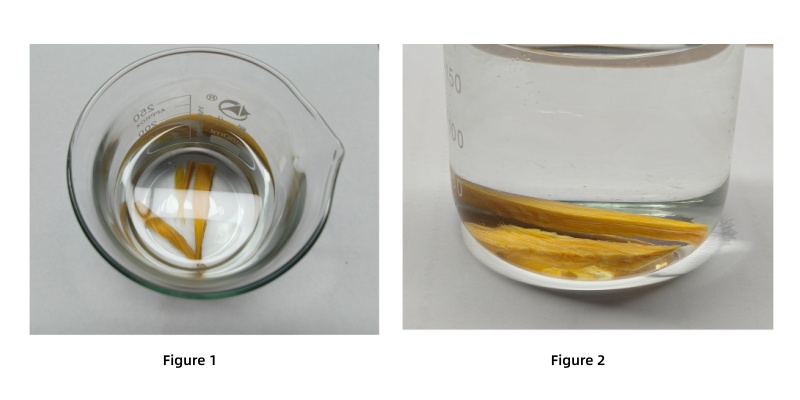
Several pieces of the sandalwood P44 sample were gently placed into a transparent container filled with room temperature water. The samples immediately sank to the bottom of the container, and were left to stand for 3 minutes. The samples remained stable at the bottom without any part floating or lifting up. The submersion rate was 100% (as shown in Figures 1 and 2). According to the classification standard in Section 2.2, it was preliminarily determined to be Grade A (Submersion Grade).
5.2 Appearance and Texture Observation
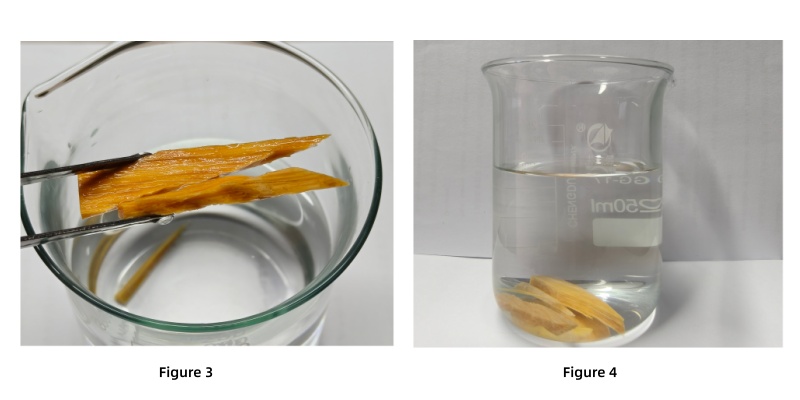
After removing the sample and drying the surface moisture, observe it: The overall color is dark brownish yellow, with rich and deep color; the surface is smooth and fine, and has a distinct natural luster; a translucent oil-like trace can be seen in the cross-section, with a firm texture and a heavy feel (Figure 3). This appearance feature is completely consistent with the A-level sandalwood standard described in Section 2.3.
5.3 Triple Odor Test Results
At room temperature: After opening the package and leaving it to stand for 1 minute, smell it. The milk fragrance base is clear and intense, the main sandalwood fragrance is prominent, the aroma is full and has a long-lasting fragrance, and there is no any off-flavor or greenish smell.
Water test experiment: Take a small amount of crushed material and soak it in water. After removing it, the aroma significantly intensifies, and the layering is more rich than when dry smelling; the soaking water remains clear and transparent throughout, without any fading or pigment dissolution phenomenon, ruling out the possibility of dyeing imitation (Figure 3, Figure 4).
5.4 Comprehensive Rating and Verification Conclusion
Both indicators point to the same result. The final determination by Tanxiang P44 is that it is a natural A-grade (submerged grade) sandalwood. This measured case demonstrates that the three-level identification system established in this paper has clear judgment boundaries, and the results from different dimensions mutually confirm each other, possessing good operability, and can provide reliable technical support for rapid quality evaluation in daily commodity circulation.
6. Conclusion
This paper systematically reviews the quality grade identification method system for sandalwood based on "appearance - immersion - odor", integrating traditional sensory identification experience with modern commodity classification requirements. It clarifies the determination indicators and typical characteristics of grades A, B, and C for sandalwood. This identification system has the following advantages: (1) Simple operation, no need for professional instruments, and can be completed by ordinary consumers at home; (2) Clear indicators, with distinct boundaries for each grade determination, reducing subjective arbitrariness; (3) Three-layer odor testing progresses step by step, effectively identifying common counterfeiting methods such as artificial coloring and fragrance imitation [2, 5].
It should be noted that the methods discussed in this paper are mainly applicable for rapid quality evaluation and initial grade determination in the commodity circulation process. For situations involving legal inspections, drug imports, scientific research analysis, etc., which require precise quantification and fingerprint pattern identification, the instruments and analysis methods such as volatile oil content determination, gas chromatography-mass spectrometry (GC-MS), and ultra-high performance liquid chromatography (UPLC) characteristic patterns should still be used for comprehensive confirmation [1, 3]. Sensory identification and instrumental analysis are not mutually exclusive; rather, they are two levels that are applicable in different scenarios and complement each other. In the context of the increasingly prominent contradiction between the rarity of sandalwood resources and market demand, establishing a multi-level quality evaluation system from simple home-based identification to precise laboratory detection is of practical significance for regulating market order, protecting consumers' rights and interests, and promoting the healthy development of the sandalwood industry.
References
[1] National Pharmacopoeia Committee. Chinese Pharmacopoeia (2025 Edition) [S]. Beijing: China Pharmaceutical Science and Technology Press, 2025.
[2] Fujian Natural Fragrance Culture Association. Classification Regulations for Sandalwood and Agarwood and Their Products (T/FJTRX 002-2023) [S].
[3] Zhang Wei. Research on Quality Characteristics and Commercial Specifications Grades of Agarwood [D]. Harbin University of Commerce, 2021. DOI: 10.27787/d.cnki.ghrbs.2021.000599.
[4] Chen Yichun, Cheng Xiaxi, Tang Zheng, et al. Comparative Identification Research on the Pharmacological Characteristics of Agarwood and Dalbergia odorifera [J]. Science and Technology Horizons, 2024, 14(1): 30-33.
[5] Li Liyue. Preliminary Study on the Quality of Volatile Oil of Market-Sold Agarwood [J]. Strait Pharmacy, 2017, 29(3): 74-76.
FAQs
Q: Why is sandalwood used in Traditional Chinese herbal bath products?
A: Sandalwood is a well-known and precious medicinal material in Traditional Chinese Medicine. It is warm in nature, and its most important action is to promote the circulation of "qi" (a TCM term referring to the functional activity of the body). With its distinctive aroma, it was frequently used in ancient times for aromatherapy and bathing. For more infos about this medicinal herb pls refer to blog about Sandalwood (Tan Xiang) .