
I.Base Origin Information
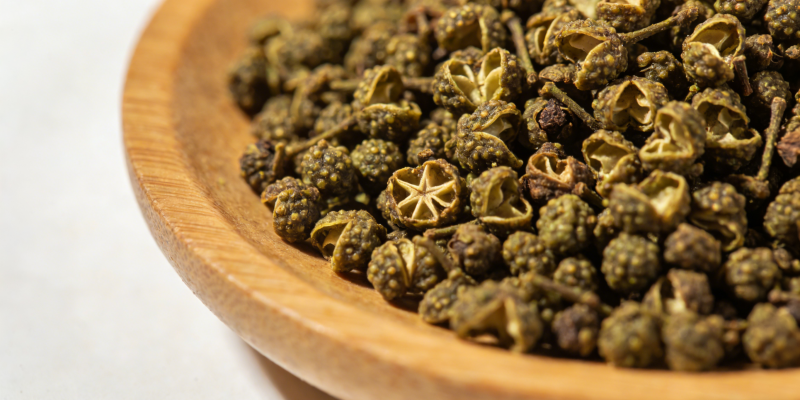
Fructus Evodiae, derived from the dried, nearly ripe fruit of the plant Tetradium ruticarpum (A. Juss.) T. G. Hartley in the Rutaceae family, is a small and seemingly inconspicuous fruit. Yet, it holds a vital role in traditional Chinese medicine as a key herb for warming the interior, dispelling cold, descending counterflow, and relieving vomiting. It has long been honored as the "foremost herb for dissipating cold." Since its documentation in the Shennong Ben Cao Jing (Divine Farmer's Materia Medica), physicians throughout history have esteemed it highly, commonly employing it to treat conditions such as Jueyin headache, cold hernia with abdominal pain, and menstrual pain. It is pungent and bitter in taste, hot in nature, and mildly toxic. Therefore, it must undergo standardized processing (e.g., preparation with licorice water) before safe use to moderate its potent properties and enhance its therapeutic effects.
II. Authentic Production Area
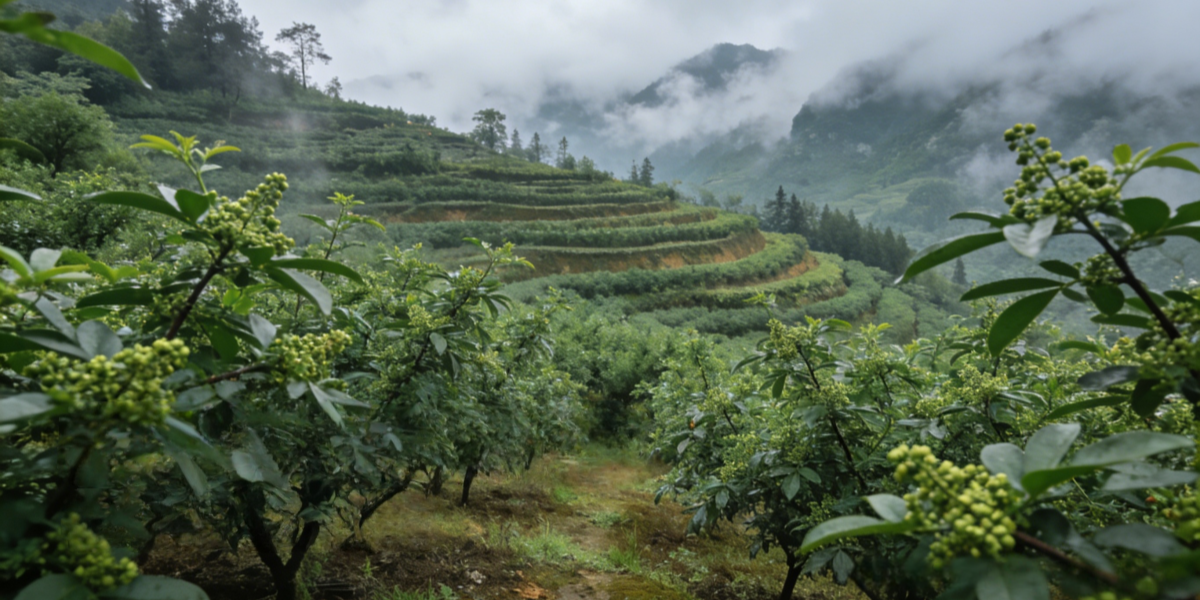
China's Guizhou, Hunan, Chongqing, Jiangxi, Yunnan, and other regions in the upper and middle reaches of the Yangtze River and the southwestern mountainous areas are the traditional authentic producing regions of Fructus Evodiae (Wu Zhu Yu). Among them, the quality from Guizhou and Hunan is the most renowned. The unique natural environment and scientific cultivation management in these areas together contribute to its superior medicinal properties,
Precise Adaptation to Geography and Climate
Fructus Evodiae thrives in warm and humid climates and is intolerant to severe cold. The authentic producing regions are mostly located in mountainous and hilly areas at altitudes of 500–1000 meters, with an average annual temperature of 16–18°C, annual precipitation of 1200–1600 mm, and a long frost-free period. This "warm, humid, and foggy" environment not only facilitates its growth but also promotes the accumulation of active compounds such as volatile bitter components and alkaloids in the fruits. Ample diffuse light (rather than strong direct sunlight) is key to ensuring the balanced synthesis of its medicinal components.
Mountain Ecological Cultivation Model
The "forest edge slope terrace cultivation method" is widely adopted, which not only conserves soil and water but also creates a well-ventilated and adequately lit growing environment. The ideal soil is loose, fertile, well-drained, and slightly acidic sandy loam. Key agricultural practices include: artificial-assisted pollination during the flowering period to increase fruit set; summer pruning of overly dense branches to concentrate nutrients for fruit development; and "soil testing and formulated fertilization," with an emphasis on supplementing phosphorus and potassium fertilizers to promote fruit growth and enrich medicinal components.
Scientific Control of Harvesting and Processing
The fruits are harvested in autumn when they turn from green to yellowish-green and have not yet fully split open. At this stage, the content of active compounds is at its highest, and the bitter-pungent aroma is most intense. A modern processing method combining "shade-drying and low-temperature drying" is employed: the fruits are first shade-dried in a ventilated area until 70% dry, followed by slow drying with hot air at ≤50°C. This method maximizes the retention of the characteristic intense aroma and pungent-warm medicinal properties while minimizing the potential overly drying effects that may arise from high temperatures.
III. Quality identification
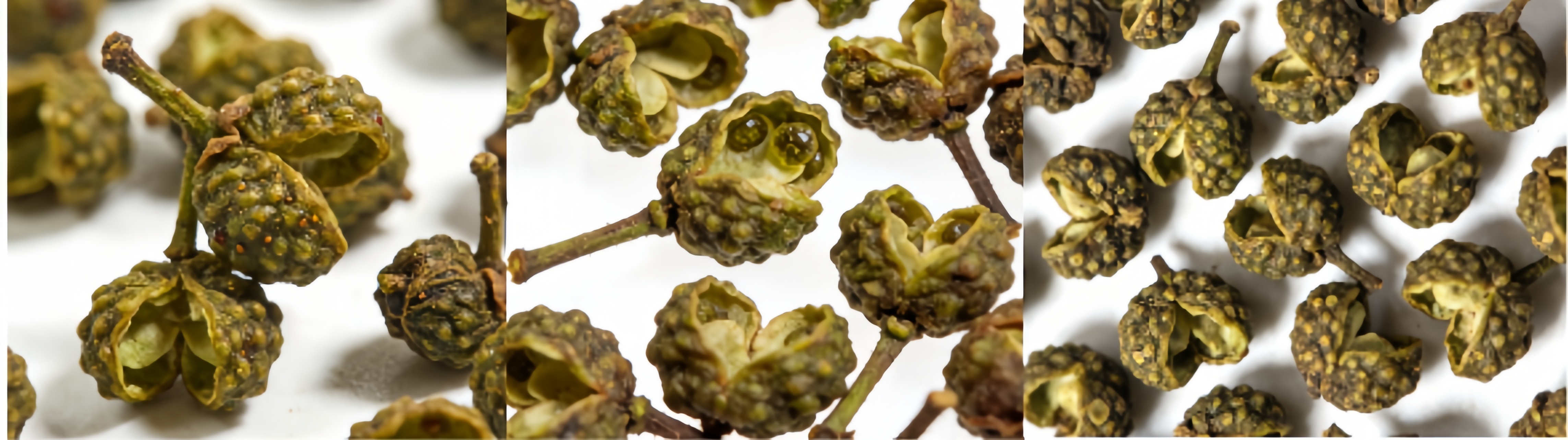
Premium grade Evodia Fruit
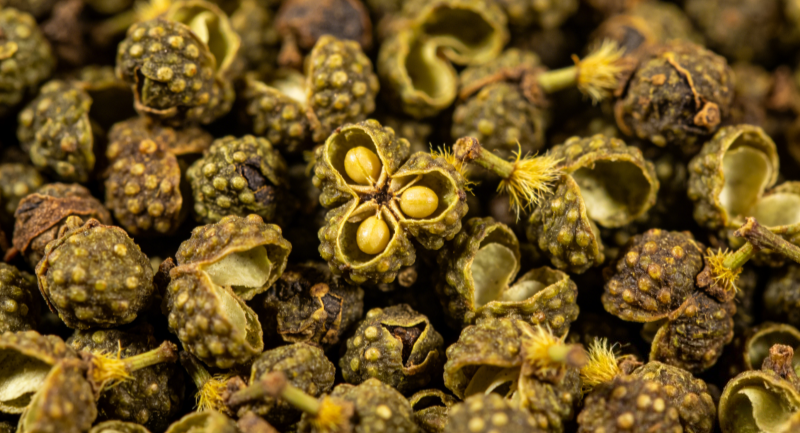
The fruit is pentagonal and oblate-spheroidal, with a diameter of 2–5 mm. The surface is dull yellowish-green to brown, coarse, and marked with numerous dotted protrusions (oil cells) and fine wrinkles. The texture is firm and not easily broken, with clearly distinguishable carpels. It possesses an intense and distinctive aroma, characterized by a strong pungent-spicy, bitter fragrance with a musky undertone. When tasted, it is pungent and intensely bitter, leaving a persistent burning and numbing sensation on the tongue. Soaking in warm water for a short while causes the liquid to gradually turn pale yellowish-green, and its characteristic pungent and intense odor becomes more pronounced. The fruit expands but does not disintegrate.
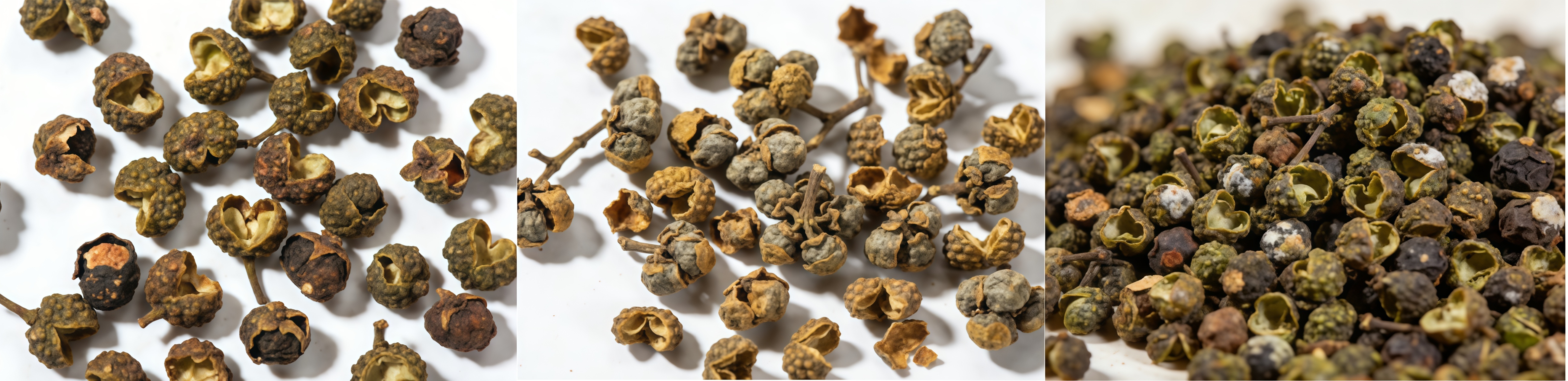
Inferior Evodia Fruit
Fruits are shriveled, undersized, or broken, with a dull, lifeless, or unnaturally yellowish-brown hue (possibly due to sulfur fumigation). Dotted protrusions are sparse or absent, the texture is lightweight, porous, and easily crumbled, and they are often mixed with a large number of impurities such as fruit stems and seeds. The aroma is weak or may carry a musty or burnt smell. The bitter and pungent taste is faint or merely astringent, lacking any sensation of heat. After soaking, the liquid becomes turbid or displays abnormal coloration (excessively dark), accompanied by an unpleasant odor. The fruits tend to disintegrate easily or turn into a pasty consistency.
IV. Main Chemical Components
Indole Alkaloids and Quinoline Alkaloids - These constitute the primary material basis for its intense bitterness, local irritant properties, as well as its analgesic, antiemetic, and adverse-qi-reducing effects.
Volatile Bitter Components- These contribute to its highly penetrating and distinctive aroma, while also exhibiting synergistic antibacterial, anti-inflammatory, and transdermal absorption-promoting effects.
Limonoid Compounds- These are associated with its role in regulating gastrointestinal motility, anti-ulcer activity, and related functions.
V. Core Efficacy
Fructus Evodiae (Wu Zhu Yu) enters the liver, spleen, stomach, and kidney meridians. Its core functions are to disperse cold and relieve pain, descend adverse qi and stop vomiting, and support yang to stop diarrhea. It is particularly renowned for its ability to guide the floating deficient fire from the upper jiao downward, making it effective in treating "upper heat and lower cold" patterns such as mouth ulcers and sore throat. When applied externally in bath sachets, its pungent, warm, and penetrating properties can be utilized safely and directly to reach and unblock the meridians. This method is especially suitable for addressing various conditions caused by cold-damp stagnation.
Powerfully Dispels Deep-Seated Cold-Damp and Relieves Cold-Type Pain
For headaches (vertex pain), cold-type hernia abdominal pain, dysmenorrhea caused by cold stagnation in the Liver Meridian of Jueyin, as well as joint cold pain and stiffness due to wind-cold-damp obstruction, the pungent and warm nature of Fructus Evodiae directly reaches the affected area. Its volatile warm-pungent components penetrate the skin powerfully under the influence of hot water and are conducted along the meridians (especially the liver and kidney meridians), deeply expelling stubborn cold and accumulated damp from the sinews, bones, and internal organs. This promotes the flow of qi and blood, providing significant relief for conditions such as "old cold legs," early-stage frostbite, and chronic pelvic cold pain.
Guides Fire Back to Its Source and Alleviates Upper Heat and Lower Cold
This herb is used to treat upper heat and lower cold patterns, such as mouth ulcers and sore throat caused by deficient fire flaring upward, accompanied by cold lower limbs, soreness, and weakness in the lower back and knees. Through herbal bathing, particularly foot baths, the "descending" property of Fructus Evodiae is guided by hot water, effectively redirecting the floating heat from the head and face downward to the kidney essence while warming the lower limbs to restore balance between the upper and lower body. This method is safe and gentle, avoiding potential gastric irritation that may occur with oral administration.
Warms the Middle Jiao and Stops Diarrhea, Relieves Deficiency-Cold Symptoms
It is used for early morning diarrhea and cold pain in the epigastrium and abdomen caused by spleen and kidney yang deficiency. During bathing, especially hip baths, the medicinal properties are absorbed through the skin of the waist and abdomen, directly warming the middle and lower jiao, stimulating spleen and kidney yang qi, and helping to alleviate discomfort related to internal cold due to visceral deficiency.
Click here to review our adaptogen bath soak with Fructus Evodiae.