I.Base Origin Information:
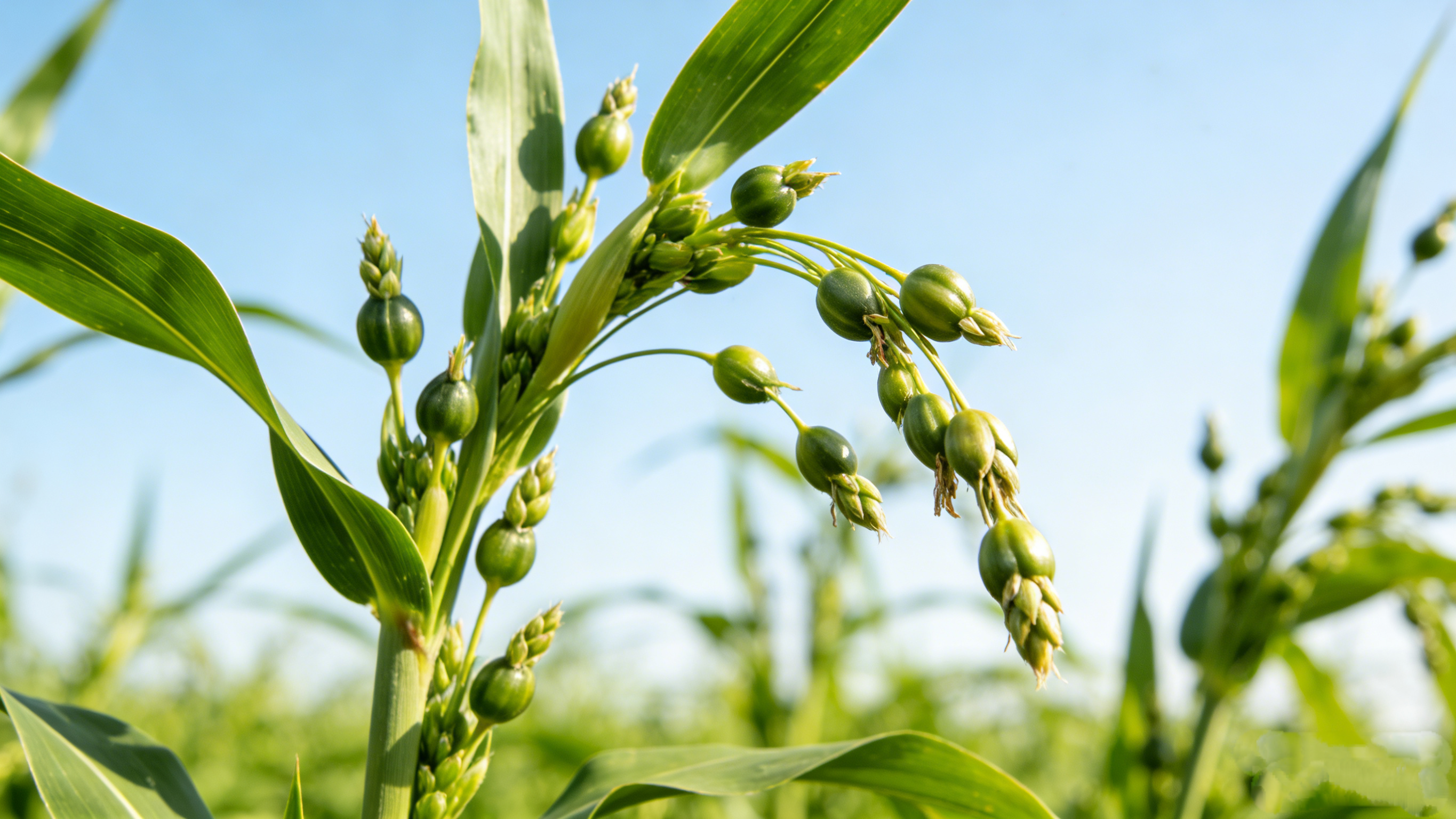
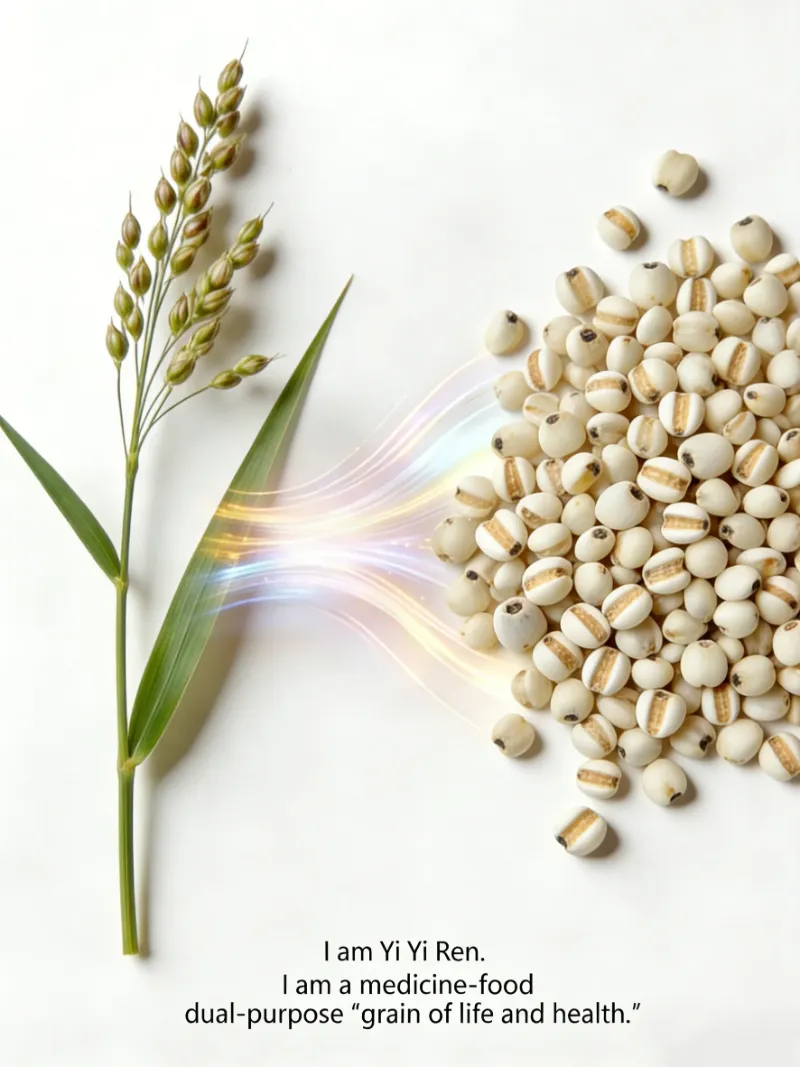
Coix Seed, with the pharmaceutical Latin name COICIS SEMEN, is the dried mature kernel of Coix lacryma-jobi L. var. ma-yuen (Roman.) Stapf, a plant belonging to the Poaceae family. [Explore Our Coix Seed Collection.]This grain, resembling jade in appearance and pearls in form, holds the esteemed reputation of being the "foremost herb for invigorating the spleen and percolating dampness" in the canon of traditional Chinese medicine. Since its inclusion in the Shennong's Classic of Materia Medica, it has been classified as a top-grade herb, renowned for its effect of "long-term consumption makes the body light and benefits qi." The name "Coix" (Yiyi) originates from Shuowen Jiezi (Explaining Simple and Analyzing Compound Characters), which states, "Yi refers to Coix; Yi also refers to this grain." The Compendium of Materia Medica notes that it is "a medicine for the Yangming meridians, capable of invigorating the spleen and benefiting the stomach." Due to its rich nutrition, balanced medicinal properties, and ability to tonify without causing stagnation, it was praised by the ancients as the "grain of life and health," serving as a paradigm of substances used both as medicine and food.
II. Authentic Production Area:
The traditional production areas of Coix Seed are located in Guizhou, Fujian, Hebei, Liaoning and other regions of China, among which the "Xingren Coix Seed" produced in Xingren City, Qianxinan Prefecture, Guizhou, is considered the most authentic in quality and is renowned as the "Hometown of Coix Seed in China."[Discover Our Authentic Xingren Coix Seed.]The unique natural conditions of these regions, combined with cutting-edge cultivation technologies, collectively contribute to its excellent medicinal properties:
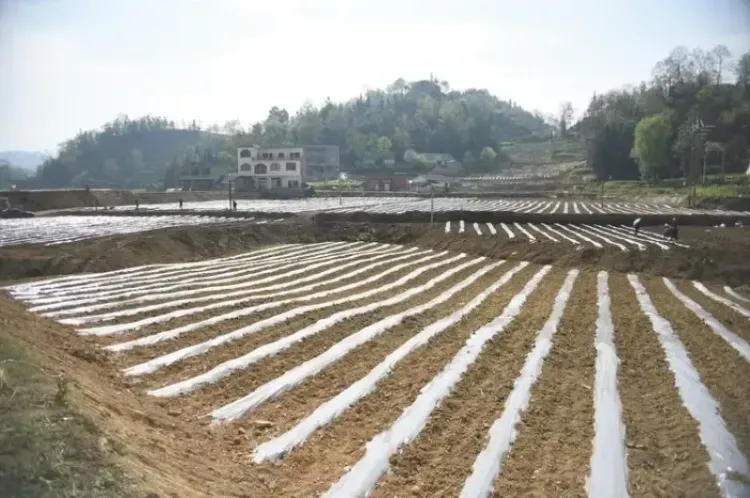
Scientific Adaptation to Geography and Climate: Argy Wormwood Leaf thrives in warm, humid climates and has strong adaptability. The authentic production area of Qichun, Hubei, is located in the eastern part of the Jianghan Plain at 30° north latitude, featuring a subtropical monsoon climate. With an average annual temperature of 16-17°C and annual precipitation of 1300-1500 mm, it experiences abundant rainfall in spring and early summer. These climatic characteristics have given rise to specific cultivation requirements—the "narrow ridge, wide furrow" planting model. Addressing Qichun's rainy conditions and heavy soil texture, this field design employs narrow ridges (40-50 cm wide) and wide furrows (20-30 cm deep), significantly enhancing drainage capacity, improving soil aeration, promoting early spring ground temperature increase, and ensuring uniform emergence of Argy Wormwood seedlings while preventing root rot caused by waterlogging. This agronomic innovation not only substantially reduces seed root usage but also effectively controls field density, suppresses weed growth, and creates conditions for green pest management and mechanized harvesting.
Technological Innovations in Ecological Cultivation:
1.Green Standardized Planting: Production areas fully implement a "Coix-green manure" crop rotation system. Green manure crops (such as common vetch and smooth vetch) are sown immediately after the Coix harvest in September each year and are plowed back into the soil during their full bloom stage in March of the following year as organic fertilizer. This model reduces the amount of chemical fertilizer used by over 30%, increases soil organic matter, and significantly enhances the content of active components in Coix Seed. Concurrently, biodiversity utilization techniques are employed, planting functional plants like marigolds and pyrethrums in the fields, using their volatile compounds to repel pests and reduce the use of chemical pesticides.
2.Scientific Water Management: Addressing Coix's preference for moist conditions, production areas innovatively adopt the "moist irrigation + field drying during flowering" technique. The field is kept moist during the tillering stage (soil water content around 80%); a shallow water layer (3-5 cm) is established during the jointing and booting stage; water is drained, and the field is dried for 3-5 days during the heading and flowering stage to promote deep root growth and the transport of photosynthates to the grains; during the filling and milking stage, alternating wet and dry conditions are maintained to meet water requirements while preventing lodging, ensuring plump grains.
3.Precise Fertilization Techniques: Based on the nutrient requirements of Coix, a formulated fertilization approach of "heavy base application, skillful topdressing, and supplemental micronutrient application" is promoted. Base fertilizer primarily consists of decomposed organic fertilizer (1500-2000 kg per mu), combined with superphosphate and potassium sulfate; urea is applied as a topdressing during the jointing stage; before heading, a foliar spray of boron fertilizer and potassium dihydrogen phosphate is applied, significantly improving the seed setting rate and thousand-grain weight.
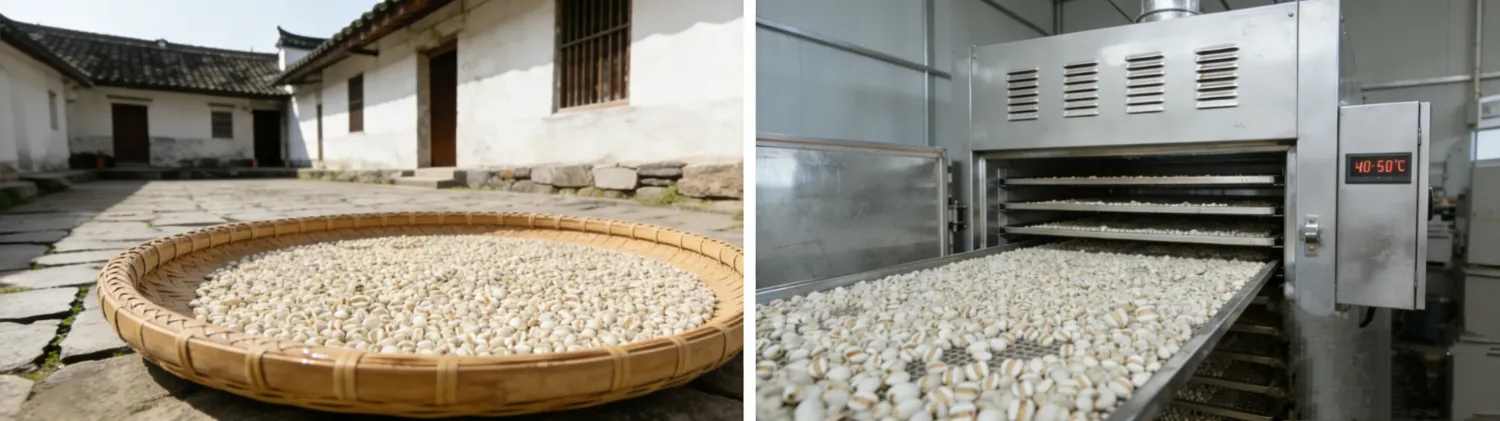
4."Property-Preserving" Techniques in Harvesting and Processing: Harvesting takes place in autumn (September to November) when the fruits turn brown and over 80% have matured. Traditionally, a "two-stage drying method" is used: first, natural sun-drying until semi-dry, then low-temperature drying at 40-50°C until the water content is ≤12%. Modern processes utilize heat pump drying technology, achieving uniform and efficient dehydration in a closed environment through dehumidification and temperature control, maximally preserving the natural color, aroma, and active components of Coix Seed, and preventing fat oxidation and loss of active constituents caused by high temperatures.
III. Quality
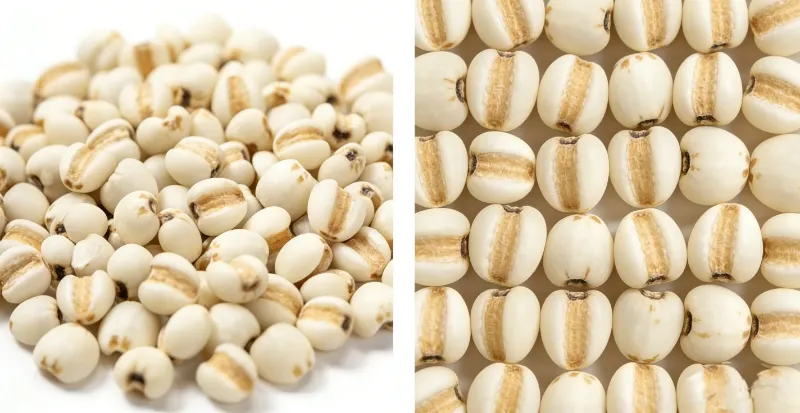
High-quality Coix Seed: The kernels are broadly ovoid or long ellipsoid in shape, measuring 4-8 mm in length and 3-6 mm in width. One end is bluntly rounded, the other end is broader and slightly concave, featuring a light brown punctate hilum. The dorsal side is rounded and convex, while the ventral side has a broad and deep longitudinal groove (ventral furrow). The grains are large, plump, and uniform in size. The surface is milky-white and smooth, occasionally with remnants of yellowish-brown seed coat. The texture is firm and solid, and the cross-section is white with abundant powdery texture. The odor is slight, and the taste is slightly sweet, with a sticky sensation when chewed (indicating high polysaccharide content). When soaked in hot water, the liquid turns milky-white, the kernels absorb water and expand, and the texture becomes soft and sticky. After cooking, the resulting liquid is thick and rich, with a pure and pleasant aroma. [Shop Coix Seed Herbal Bath Tea Bags.]
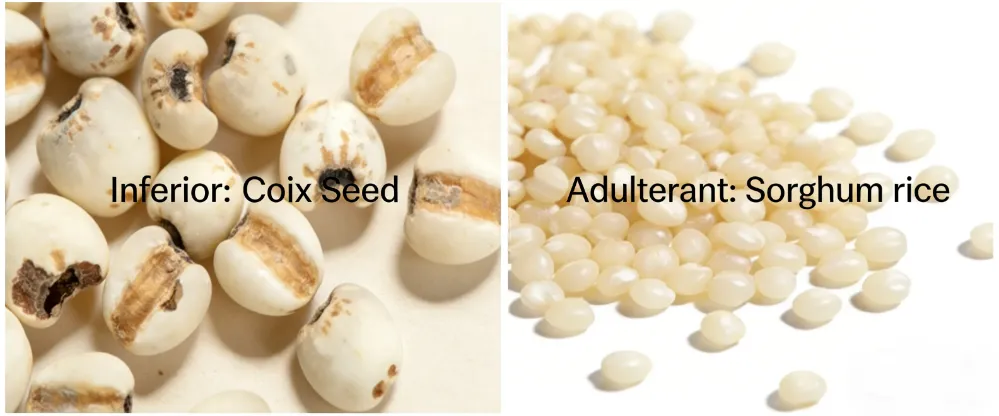
Ordinary/Inferior Coix Seed: The grains are small, thin, shriveled, and uneven in size. The ventral furrow is shallow, flat, or indistinct. Common adulterants include: sorghum rice (lacks a ventral furrow), barley (has a ventral furrow but both ends are pointed), and Job's tears seeds (one end has remnants of blackish-brown seed coat). The color is grayish-white or dull, lacking luster. The texture is light and porous or dry and brittle, easily broken, with poor powdery quality. The taste is bland, lacking stickiness when chewed, or may have a musty odor, rancid taste (fat oxidation), or sour taste (sulfur fumigation). When soaked, the liquid remains clear or becomes abnormally turbid, and the kernels expand poorly. After cooking, the resulting liquid is thin and lacks viscosity. When baked with fire, high-quality Coix Seed emits a faint, pleasant grain aroma, while low-quality products may produce a burnt or unpleasant odor.
IV.Main Chemical Components
1.Ester Compounds (Coixenolide): These are the characteristic active components of Coix Seed and constitute the material basis for the content determination of "triolein" as specified in the Chinese Pharmacopoeia. Modern research has confirmed that they possess various pharmacological activities, including anti-tumor, immunomodulatory, and lipid-lowering effects, closely related to its efficacy of "clearing heat and draining pus."
2.Coixol (Coix Lactam): This compound exhibits sedative, analgesic, antipyretic, and skeletal muscle relaxant effects, serving as an important material basis for its efficacy of "relieving impediment and alleviating pain."
3.Polysaccharide Compounds: These are the core components responsible for the spleen-invigorating, qi-replenishing, and immune-enhancing effects of Coix Seed, and are also the source of the "sticky sensation" when tasted. They possess activities such as regulating intestinal flora, protecting the gastric mucosa, and anti-tumor effects.
4.Fatty Acids and Their Esters: Rich in unsaturated fatty acids such as oleic acid and linoleic acid, these components have lipid-lowering, anti-atherosclerotic, and skin-nourishing effects.
V.Core Efficacy
Coix Seed is cool in nature, sweet and bland in taste, and acts on the spleen, stomach, and lung meridians. Its core efficacies are "invigorating the spleen and percolating dampness, relieving impediment and stopping diarrhea, and clearing heat and draining pus." Its medicinal property is mild and balanced; it invigorates the spleen without promoting dampness and percolates dampness without injuring yin, making it an excellent substance for "supporting the righteous qi and dispelling pathogenic factors." When used externally in the form of a "bath bag," its bland and percolating, dampness-eliminating nature can leverage the warming and moistening properties of water to penetrate the skin, exerting its unique effects of "percolating dampness and discharging turbidity, and moistening the skin and beautifying the complexion."
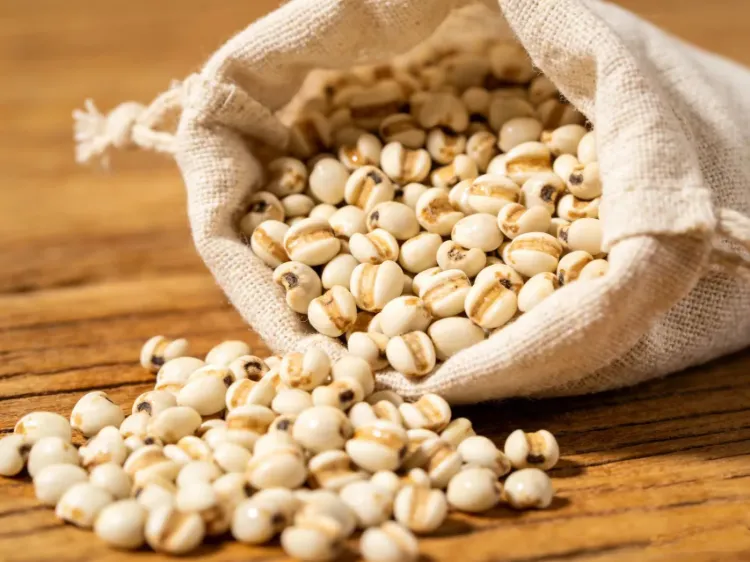 Click here to see our adaptogen bath soak with Coicis Semen.
Percolating Dampness and Discharging Turbidity, Improving Eczema and Itching:
It has a good effect on eczema, skin itching, beriberi, and edema caused by spleen deficiency with exuberant dampness, effectively percolating damp turbidity from the skin. Its components like coixol and polysaccharides are fully released in hot water and, through transdermal absorption, gently percolate and eliminate dampness retained within the skin tissues. For eczema patients (often considered in TCM to be related to spleen deficiency with damp accumulation), a Coix Seed medicinal bath can assist in resolving dampness and relieving itching, reducing exudation. Long-term use can help improve a damp constitution.
Moistening the Skin and Beautifying the Complexion, Improving Roughness and Dryness:
Its richness in fatty oils and B vitamins can nourish the skin, improving roughness and chapping. The esters and polysaccharides in Coix Seed can form a gentle, nourishing film on the skin's surface, locking in moisture and enhancing skin elasticity. Long-term use can make the skin supple, smooth, and brighten the complexion. This is the modern cosmetic interpretation of the ancient text's description of "long-term consumption makes the body light and benefits qi."
Relaxing Sinews and Relieving Impediment, Alleviating Muscle Soreness:
It offers auxiliary relief for rheumatic impediment pain, spasms and contracture of sinews and vessels, and muscle soreness. Its power of "relieving impediment," combined with the warming and relaxing effect of the hot bath, promotes blood circulation in the limbs, alleviates muscle stiffness and sensations of heaviness and soreness caused by damp encumbrance or fatigue. It is particularly suitable for post-exercise recovery or individuals engaged in prolonged sedentary work.
FAQ:
Which type of bath soak is more recommended ? Of raw herbs,powders or concentrated liquor ?
Three types of bath soak own their advantages and disadvantages ( Which type of adaptogen bath bag is more recommended: raw herb form, powder form, or liquid form?).
From the effect perspective, bath soak in raw herb is in coarse particles, its form is complete, real and visible, the quality can be identified, and it cannot be adulterated, and it maximally retains the effective substances and volatility of the original medicinal herbs, making it the most recommended type for home bathing — also the preferred form for high‑efficiency herbal bath tea bag.
Currently, all our products are of raw herb type, only undergoing necessary physical processing and rough cutting, 100% natural pure and zero additives, with visible quality.